
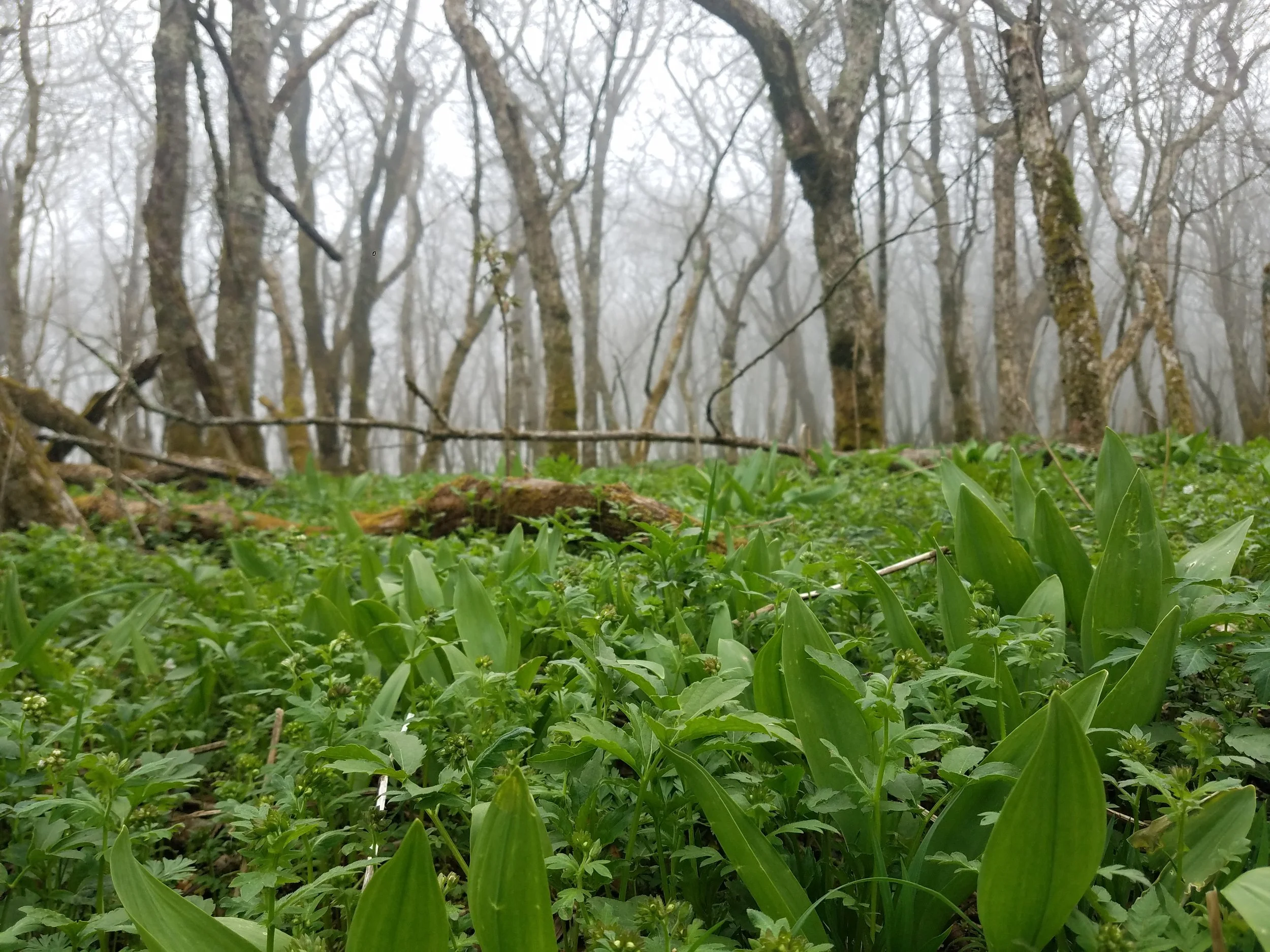
Willard’s Wonderings & Watauga Wanderings is a special program series hosted by BRAHM’s Programs & Outreach Director Willard Watson III. At each session, Willard will be joined by fascinating individuals working in riveting jobs throughout the High Country. Join us for an engrossing conversation about the place we live in & love.
About the Research
Ramps (Allium tricoccum Aiton), or wild leeks, are perennial herbaceous plants native to the
forests of eastern North America and valued for their distinctive flavor and cultural significance.
Despite increasing harvest pressure, relatively little is known about their genetic diversity or
taxonomic boundaries. While ramps reproduce both clonally through bulb division and sexually
through seed production, the extent to which these modes shape population diversity remains
unclear. Additional uncertainty surrounds species delineation within the group, with as many as four taxa historically proposed.
Dr. Estep's research provides the first preliminary genetic evidence supporting the recognition of a second ramp taxon—narrow-leaf ramps. His colleagues are expanding their surveys
to verify other Ramp species. Together, this work establishes foundational genetic tools for
understanding ramp taxonomy and informs conservation strategies for this increasingly exploited forest species.
About the Speaker

Matt Estep is a plant geneticist whose work integrates evolutionary biology, molecular genetics, and conservation. An alumnus of the Appalachian State University Department of Biology, he earned his B.S. in Biology Education in 1999 and completed his M.S. in 2002, conducting early research on the phylogeography of scorpions.
After graduate school, Estep served as a Peace Corps volunteer in the Philippines, where he
worked on coral reef conservation—an experience that strengthened his commitment to applied conservation science and global ecological stewardship.
He pursued doctoral training in the laboratory of Jeff Bennetzen at the University of Georgia,
focusing on the evolutionary genetics of parasitic plants. His postdoctoral research at the
University of Missouri–St. Louis, with Toby Kellogg, further expanded his expertise to the
phylogenetics of grasses and the dynamics of genome evolution.
Estep joined the faculty at Appalachian State University in 2012. His research program centers
on the population genetics of rare, threatened, and exploited plant species, with an emphasis on generating data that supports conservation decision-making. His work spans molecular marker development, population structure analysis, and evolutionary questions related to plant
persistence and adaptation.